
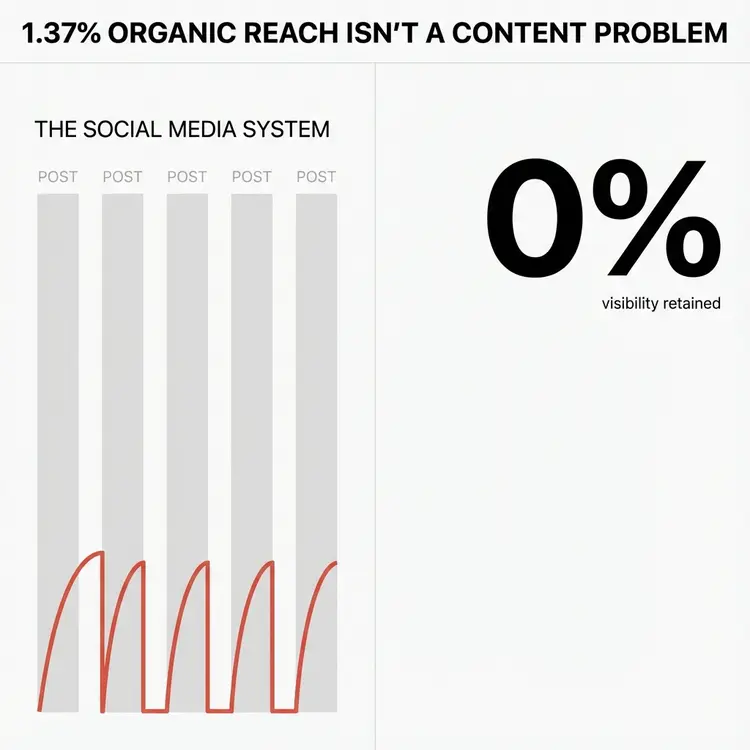
Each spike represents a single social post—briefly visible, then reset to zero without carrying forward.
Facebook’s organic reach sits at 1.37%. Instagram averages 4.0% and dropped 18% year over year. If you’re posting consistently but seeing flat growth curves, the numbers confirm what you’re experiencing. The problem isn’t your content quality or posting frequency.
The problem is structural.
This article is not about social media tactics, posting schedules, or algorithms. It’s an examination of why visibility fails to accumulate for most local businesses—even when they are active, consistent, and doing what they’ve been told works.
The Visibility Reset Problem
In a functioning system, effort leaves residue. Reach, discovery, and trust compound over time. When they don’t, three signals tell me the system is structurally broken.
First, visibility resets instead of accumulating. Every post starts from zero in terms of durable distribution. Past engagement may influence short-term amplification, but it does not create cumulative reach.
Second, cross-reinforcement is absent. Social posts don’t meaningfully feed website traffic. Google visibility doesn’t improve. Review velocity remains unchanged. Each channel operates independently, so volume becomes irrelevant.
Third, there’s no anchor asset. No long-form content. No indexed destination. No discovery surface that continues working after the post expires.
At that point, you can increase effort indefinitely and still get flat growth curves.
Why Volume Fails Without Integration
Most businesses assume posting more frequently solves the visibility problem. It doesn’t. Increased volume amplifies decay, not accumulation.
Social platforms are designed around rapid content expiration. When channels are structurally disconnected, each additional post behaves as an independent unit with a fixed lifespan. Posting more frequently produces more short-lived events, not a growing system.
The structural conditions required for compounding are absent. Volume increases activity but doesn’t change the underlying mechanics of how visibility is retained.
Here’s what actually happens. Posts generate engagement signals that never consolidate. Traffic doesn’t converge toward a central asset. Google visibility doesn’t strengthen. Reviews aren’t influenced. Each channel remains informationally isolated, so the system can’t recognize or reward momentum.
In an integrated system, volume has leverage because each action strengthens existing assets. In a disconnected system, volume only increases effort.
Where Effort Actually Accumulates
Effort compounds only when it creates assets that persist beyond the moment of activity.
| Activity Performed | Persistent Residue |
| Posting | Indexed pages |
| Engaging | Branded searches |
| Boosting | Reviews |
| Chasing reach | Return Visits |
When a system works, effort leaves residue in three places: discoverability, credibility, and navigational gravity.
Discoverability means long-form content becomes indexed. Pages gain relevance signals. Search surfaces begin to recognize patterns of authority. This creates persistent visibility that doesn’t require continued posting to exist.
Credibility accumulates through repeated exposure to consistent ideas across platforms. Google reviews, structured content, and coherent messaging reinforce one another. Over time, this creates a bias toward the business before any direct interaction occurs. That credibility doesn’t reset when posting pauses.
Navigational gravity emerges when social posts, profiles, and search results all point toward a clear destination—typically a website with substantive content. Attention has somewhere to land. Traffic patterns stabilize. Return visits increase. The business becomes easier to re-find, not just momentarily visible.
When these forms of residue build simultaneously and reinforce each other, visibility compounds. When they don’t exist, effort evaporates.
The Anchor Asset Requirement
Long-form content functions as an anchor because of three properties: persistence, addressability, and reinforcement capacity.
Anchor content lives at a stable URL. It’s indexable by search engines. It can be consistently pointed to from multiple channels. Social posts are ephemeral by design. Once they pass through the feed, they become difficult to rediscover and rarely resurface organically.
Anchor content accumulates signals over time. Search engines observe it being referenced, linked to, revisited, and expanded upon. Each interaction strengthens the asset instead of resetting it. That accumulation is what allows visibility to compound.
Multiple short-form posts can point toward the same long-form asset, each adding context and relevance rather than competing for attention. Over time, this creates thematic density around a topic. Algorithms and users both begin to associate the business with a specific area of expertise.
Long-form content only decays when it’s treated as isolated output. When it’s positioned as a reference point within an integrated system, it persists, accumulates, and gives every other piece of content something stable to reinforce.
How Google and Reviews Amplify the System
Google visibility and reviews operate as validation layers that sit downstream of attention. When website, long-form content, and social distribution are connected, Google becomes the place where that accumulated signal is evaluated and either reinforced or throttled.
The amplification begins with convergence. When social posts consistently point toward substantive content on a website, traffic patterns become predictable rather than sporadic. Google observes repeated pathways: content being discovered, visited, revisited, and navigated further. That consistency strengthens relevance signals and increases the probability of broader discovery across related searches.
Reviews amplify this effect by reducing friction at the decision layer. Businesses with 10 or more reviews see a 15-20% boost in search traffic. When reviews are active, recent, and aligned with the themes being communicated elsewhere, they reinforce trust at the exact moment a user is evaluating credibility.
That trust doesn’t just influence conversion. It feeds back into engagement behavior, dwell time, and repeat interactions, which further strengthen visibility signals.
Reviews influence engagement by changing how users behave after discovery. If reviews are recent and consistent with expectations set elsewhere, users spend less time validating the decision externally. They stay longer on the business’s assets—reading content, exploring pages, or interacting with the Google Business Profile itself.
Once trust is established, users return directly. They search the business name instead of a generic query. They revisit the website. They engage with future content. Those branded searches and return visits are strong indicators that the business is being remembered rather than rediscovered from scratch each time.
Neither Google visibility nor reviews work well in isolation. Reviews without discoverability go unseen. Discoverability without trust underperforms. When content, distribution, and destination are integrated, Google and reviews stop acting as endpoints and instead become multipliers.
What Restructuring Actually Requires
Restructuring requires changing what each component of your online presence is responsible for. Most businesses don’t fail because they lack activity. They fail because every channel is asked to do everything at once.
Social media stops being treated as the primary asset and becomes a distribution layer. Its role is no longer to perform or convert in isolation, but to direct attention toward something persistent. That immediately changes how posts are written, what they link to, and how success is measured.
The website shifts from being a static brochure to becoming the system’s anchor. It must host long-form content that explains, contextualizes, and compounds over time. This content becomes the reference point that all other activity reinforces.
Google visibility is restructured from a passive listing into an active reinforcement layer. The Google Business Profile, search presence, and reviews are aligned with the same themes being communicated elsewhere. Instead of operating independently, they confirm and amplify the same signals.
Operationally, this requires a shift in measurement. Instead of tracking individual post performance, you begin observing convergence. Are multiple channels pointing to the same assets? Is visibility persisting when activity pauses? Are return visits increasing?
These indicators reflect structural health, not output volume.
The work being done often stays the same. But its placement changes. The system is redesigned so that each action strengthens existing assets instead of expiring on its own.
When that restructuring is complete, compounding becomes possible. Not because more is being done, but because what’s already being done finally works together.
What This Means for Your Business
If you’re posting consistently but seeing flat growth curves, the issue isn’t effort. It’s structure. Isolated social posts decay immediately. Disconnected channels generate signals that never consolidate. Volume without integration amplifies activity but produces no momentum.
The solution isn’t posting more. It’s restructuring what you’re already doing into an integrated system where effort leaves residue, signals consolidate, and visibility compounds over time.
That’s the difference between activity and momentum.